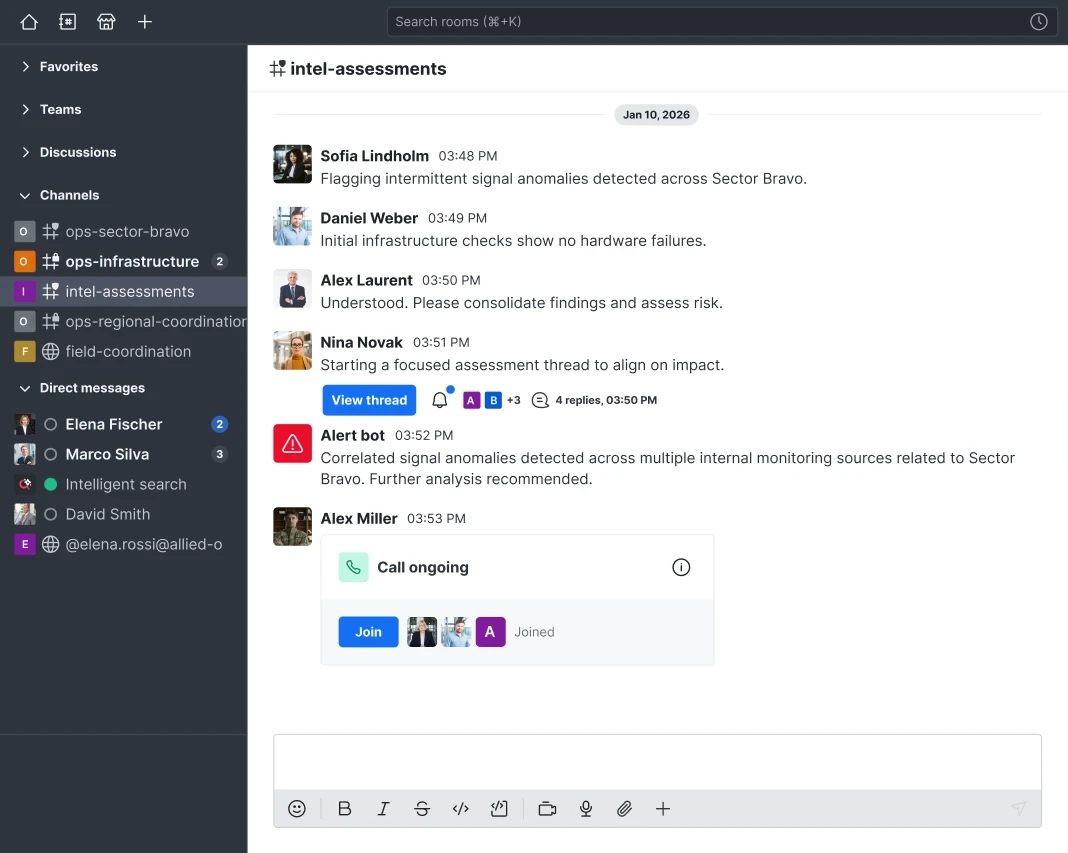
01What a government messaging app actually is
A government messaging app is a secure communication platform built specifically for the operational, legal, and security requirements of public sector organizations. It is not a consumer app with added security settings. It is purpose-designed to handle sensitive information, enforce access controls, and meet compliance frameworks that consumer-grade tools do not address.
According to Gartner research on workplace communication, instant messaging has overtaken email as the primary mode of internal communication in many organizations. In government, that shift carries significant risk if the tools chosen were not built for the environment.
The distinction matters because the consequences of a data breach in a government context extend beyond commercial liability. Operational security, classified communications, citizen data, and national infrastructure decisions may all pass through these systems.
02Why consumer apps are not an option
Government chat platforms exist because the alternative, consumer apps, create specific and well-documented risks. These risks are not theoretical.
Consumer messaging applications were built for scale and convenience. They were not built for security, auditability, or compliance with public sector legal frameworks. The gaps include:
- No guaranteed end-to-end encryption for all message types, including file transfers
- No audit trail or archiving capability that meets legal retention requirements
- No robust identity verification, which creates vulnerability to phishing and social engineering
- No administrative controls to prevent accidental or deliberate sharing of classified or sensitive material
- Data stored or processed in jurisdictions outside the government's legal authority
The European Union Agency for Cybersecurity (ENISA) has documented the risks of uncontrolled third-party communication tools in its guidelines on network and information security. A government organization using unapproved consumer apps is not just operating insecurely; it may be in breach of NIS2 obligations that came into force for EU member states in 2024.
A Microsoft Teams alternatives analysis is also worth reviewing for organizations evaluating how mainstream enterprise tools compare against sovereign requirements.
03Six features that define a government messaging app
1. End-to-end encryption
End-to-end encryption ensures that messages can only be read by the sender and intended recipient. No third party, including the platform vendor, can access the content in transit or at rest. This is a baseline requirement for any platform handling sensitive government communications. End-to-end encryption for government covers the technical and regulatory case in detail.
2. Regulatory compliance
Government messaging platforms must meet specific certifications and legal frameworks. In the EU, GDPR Article 32 requires appropriate technical and organizational measures to secure personal data, which includes communications. NIS2 extends this to entities operating critical infrastructure. In the US, FedRAMP certification is the standard for cloud services used by federal agencies.
Compliance is not a feature that can be retrofitted. Platforms need to be architected for it from the ground up. For organizations operating across jurisdictions, GDPR-compliant messaging requirements apply to any system processing EU residents' data, regardless of where the platform vendor is headquartered.
3. User authentication
Strong identity verification prevents unauthorized access. Multi-factor authentication (MFA) and single sign-on (SSO) integration are standard requirements for government deployments. Biometric authentication is increasingly used for mobile access in sensitive environments. Without reliable identity controls, encryption alone is insufficient.
4. Data sovereignty
Data sovereignty means the government retains full legal and operational control over where its data is stored, processed, and governed. For many agencies, this requires on-premises deployment or hosting within national borders. A sovereign Slack alternative for Europe addresses this for EU public sector specifically.
Digital sovereignty is becoming a procurement requirement, not just a preference, particularly in Nordic and Central European markets where government-wide data residency policies are being formalized.
5. Interoperability
Government agencies rarely operate in isolation. A platform that cannot integrate with existing systems, including case management tools, identity providers, and emergency communications infrastructure, creates operational friction. Interoperability with military messaging systems is also a requirement for defence agencies.
6. Deployment flexibility
Agencies have different risk profiles and infrastructure constraints. The platform must support cloud, on-premises, and air-gapped collaboration environments, depending on classification level and operational context. A classified environment may require complete network isolation. A municipal government may operate comfortably on a private cloud. The platform should accommodate both.
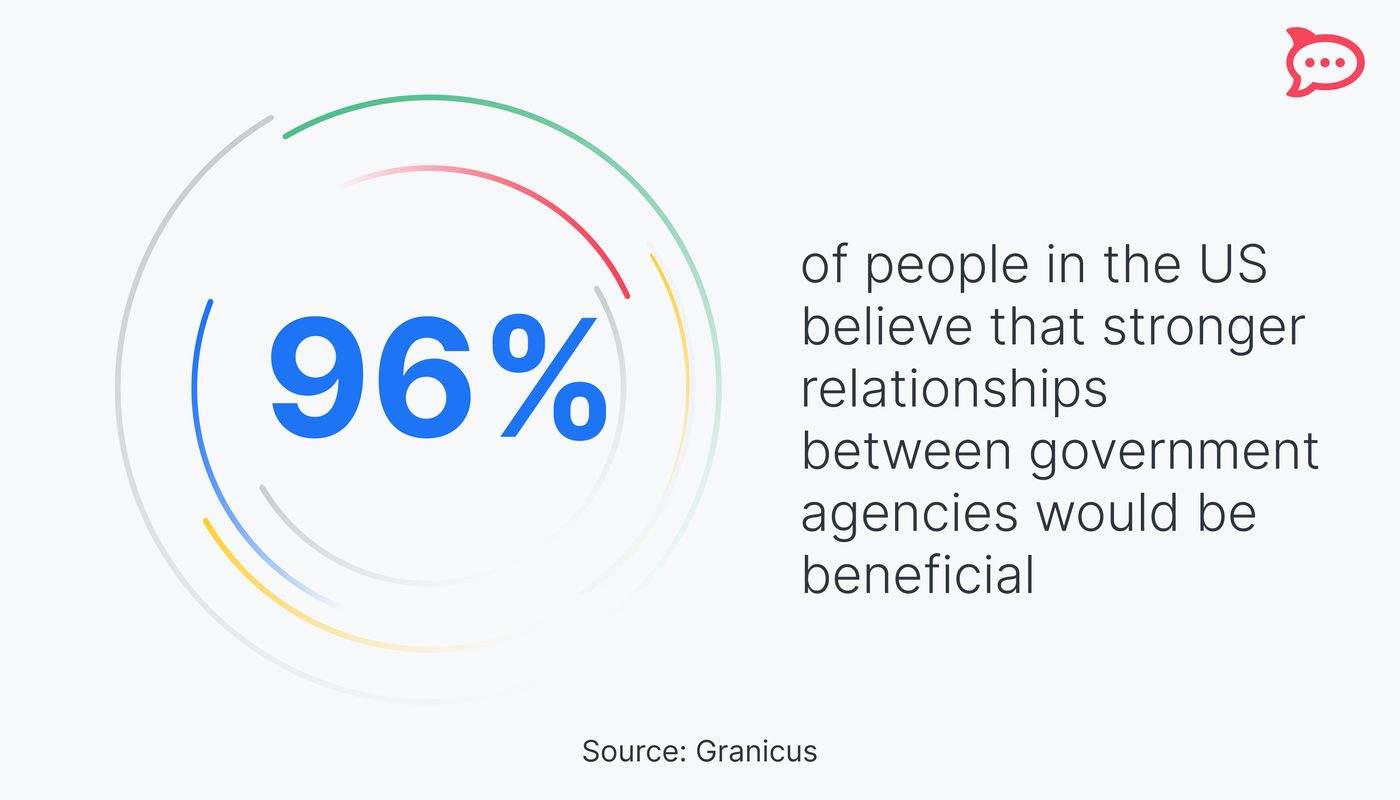
04How consumer apps compare to purpose-built platforms
| Feature | Consumer apps WhatsApp, Telegram | Government messaging app |
|---|---|---|
| End-to-end encryption | Partial (not all message types) | Full, across all content types |
| Audit and archiving | None | Configurable retention and export |
| Identity verification | Phone number only | MFA, SSO, biometric |
| Data sovereignty | Vendor-controlled | Agency-controlled |
| Compliance certifications | None | GDPR, FedRAMP, NIS2-aligned |
| Deployment options | Cloud only | Cloud, on-prem, air-gapped |
| Administrative controls | Limited | Granular role-based access |
05Evaluating and selecting a platform
Security audits
Before deploying any platform, agencies should conduct independent security assessments. Penetration testing, code audits for open-source platforms, and review of the vendor's own certifications are all part of a credible evaluation process. Vendor-provided security documentation is a starting point, not sufficient on its own.
Compliance verification
The platform must demonstrate compliance with applicable frameworks, not just claim it. For EU agencies, this means evidence of GDPR Article 32 alignment and, where relevant, NIS2 technical measures. For UK public sector, alignment with secure messaging for European governments guidance and NCSC principles applies.
Deployment model selection
The right deployment model depends on the classification of data being handled and the agency's infrastructure policy. According to ENISA's cloud security guidance, public sector organizations should assess cloud services against national security frameworks before adoption, even when vendors hold recognized certifications. For agencies handling operational or classified material, self-hosted government chat offers full infrastructure control.
Training and change management
A secure platform only delivers its intended protection if staff use it correctly. User training on classification, access controls, and incident reporting is a deployment requirement, not an optional extra. The NCSC's guidance on securing communications identifies human behavior as a consistent vulnerability in otherwise secure environments.
Open-source architecture
Open-source platforms allow agencies to inspect the codebase, verify security claims independently, and adapt the platform to operational requirements without depending on a vendor roadmap. For government organizations with long procurement cycles and strict supply chain controls, open-source offers a meaningful security and operational advantage.
06Top government messaging app providers
The following platforms are used by government and defence organizations:
- Rocket.Chat — open-source, supports air-gapped and on-premises deployment, used by defence and public sector agencies globally
- Mattermost — open-source, strong US federal track record, self-hosted
- Wickr (AWS) — end-to-end encrypted, used in US defence contexts
- Vaporstream — compliance-focused, used in regulated industries
- TroopMessenger — designed for defence and paramilitary organizations
For European public sector specifically, government communication platforms with EU data residency options are increasingly preferred over US-headquartered vendors, particularly after the Schrems II ruling invalidated Privacy Shield.
According to the ENISA Threat Landscape 2023 report, supply chain attacks on communication platforms are among the most significant threat vectors facing public sector organizations, reinforcing the case for deployments where the agency maintains direct infrastructure control.
Military chat and civilian government platforms share most technical requirements but differ on classification handling and physical security requirements for the infrastructure itself.
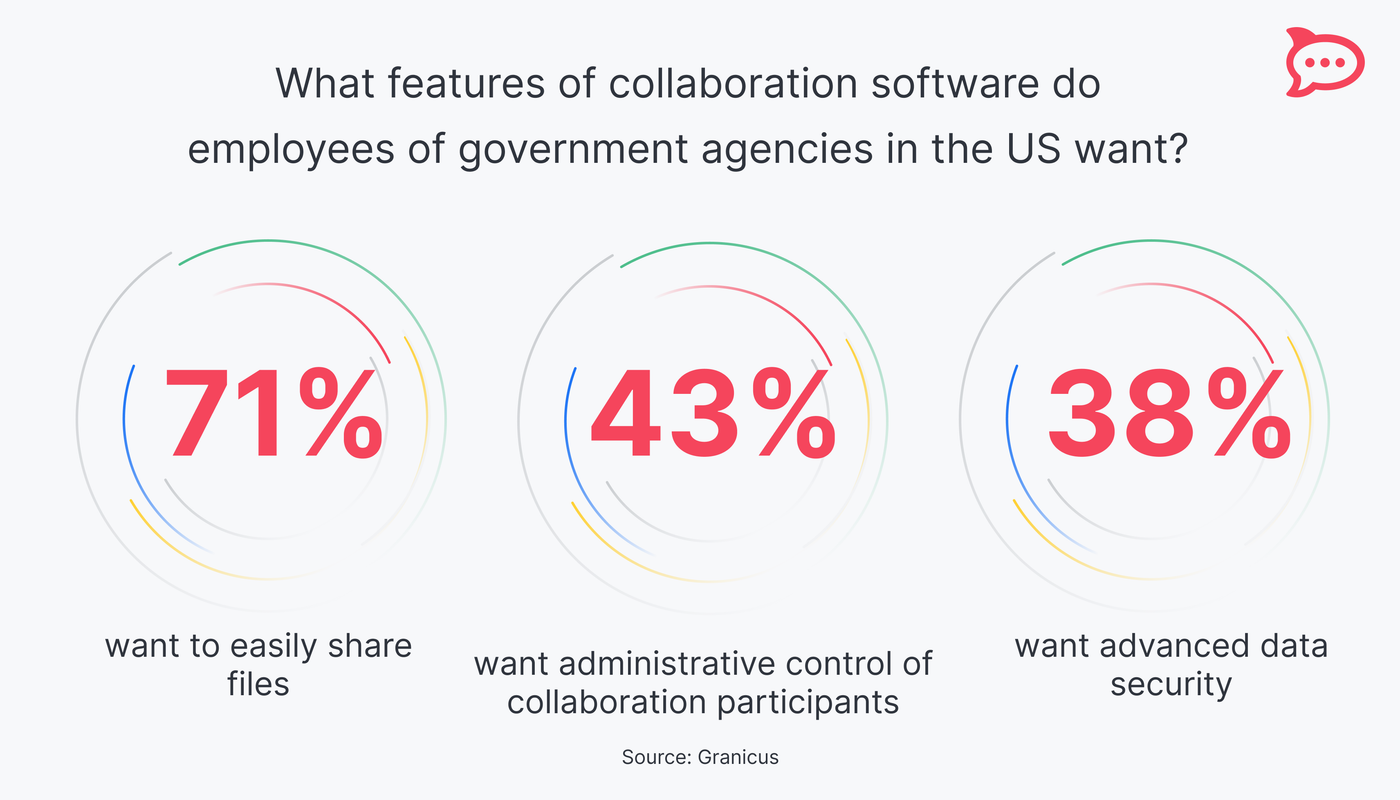
07Rocket.Chat for government
Rocket.Chat is an open-source platform used by government agencies, defence organizations, and critical infrastructure operators across Europe and North America. It supports deployment across cloud, on-premises, and fully air-gapped environments. Agencies can inspect the source code, configure access controls to match their classification policy, and integrate with existing identity and case management systems. For organizations working through the question of what government messaging app requirements apply in their context, Rocket.Chat's public sector team works directly with procurement and security teams to scope deployments.
Frequently asked questions
What is a government messaging app?
A government messaging app is a secure communication platform purpose-built for public sector organizations. Unlike consumer apps, these platforms provide end-to-end encryption, audit trails, compliance certifications, and data sovereignty controls that government use requires.
What regulations apply to government messaging tools in the EU?
GDPR Article 32 requires appropriate technical security measures for any system processing personal data, which includes government communication platforms. NIS2 extends security obligations to entities operating essential services and critical infrastructure across EU member states. Organizations should verify compliance with their own legal advisors given that requirements vary by sector and member state.
Can government agencies use WhatsApp or Telegram?
No, not for official communications involving sensitive, classified, or personally identifiable information. Consumer messaging apps lack the audit trails, encryption standards, and administrative controls that public sector security policies require. Several EU member state governments have formally prohibited the use of consumer apps for official government communications.
What is data sovereignty in the context of government messaging?
Data sovereignty means the government retains legal and operational control over where its data is stored and processed. In practice, this means either on-premises deployment or hosting within national borders under the jurisdiction of national law. Platforms hosted by foreign vendors may expose government data to legal access requests under the vendor's home jurisdiction, regardless of where the data is physically stored.
What is the difference between cloud and air-gapped deployment for government messaging?
Cloud deployment hosts the platform on remote servers, which can be vendor-managed or government-managed within a private cloud. Air-gapped deployment means the platform runs on a physically isolated network with no connection to the public internet. Air-gapped environments are used for classified or operationally sensitive communications where any external network exposure is unacceptable.
Is open-source messaging software more secure for government use?
Open-source platforms allow independent inspection of the codebase, which supports supply chain security and reduces dependence on a single vendor's security claims. Government security agencies, including ENISA, have identified supply chain integrity as a critical consideration. Open-source does not guarantee security by itself, but it enables a level of transparency and adaptability that proprietary software does not.
What should agencies prioritize when selecting a government messaging app?
Agencies should assess end-to-end encryption coverage, compliance certification against applicable frameworks, deployment model flexibility, identity management integration, and vendor supply chain controls. Security audits and reference checks with comparable public sector deployments are also recommended before committing to a platform.