01What is GDPR compliant business messaging?
GDPR compliant business messaging is the practice of exchanging organizational communications in a way that fully satisfies EU Regulation 2016/679 — covering how personal data within those messages is collected, stored, processed, and deleted.
The regulation applies to any business that handles the personal data of EU residents, regardless of where the business is headquartered. That includes employee chats, customer support conversations, file transfers, and any metadata associated with those exchanges.
Since GDPR took effect in May 2018, the regulatory landscape has only tightened. According to the GDPR Enforcement Tracker, hundreds of fines are issued every year across sectors — and messaging platforms are increasingly cited as a weak point in organizational data handling.
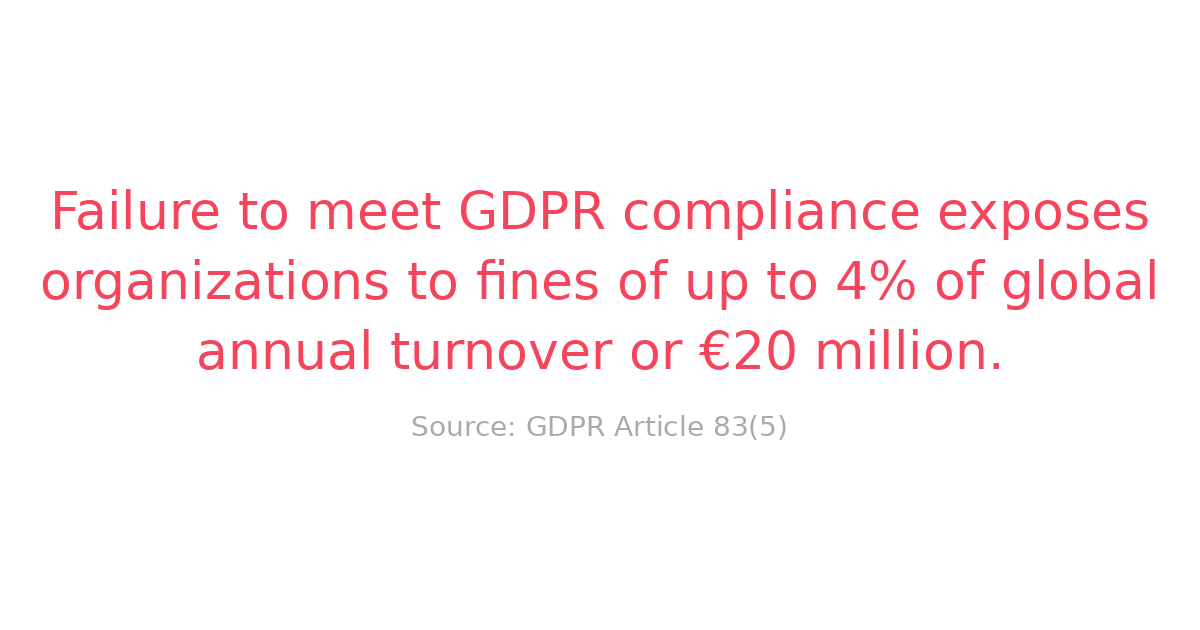
For businesses operating in the EU, compliant messaging is not optional. It is a legal baseline, and failure to meet it exposes organizations to fines of up to 4% of global annual turnover or €20 million, whichever is higher.
02Why GDPR compliance in messaging is a growing business risk
The scale of the problem
Messaging and collaboration tools have become the central nervous system of modern organizations. Teams use them to share sensitive files, discuss client data, and coordinate across borders. Yet many businesses deploy consumer-grade or non-EU-hosted platforms that were never designed with GDPR in mind.
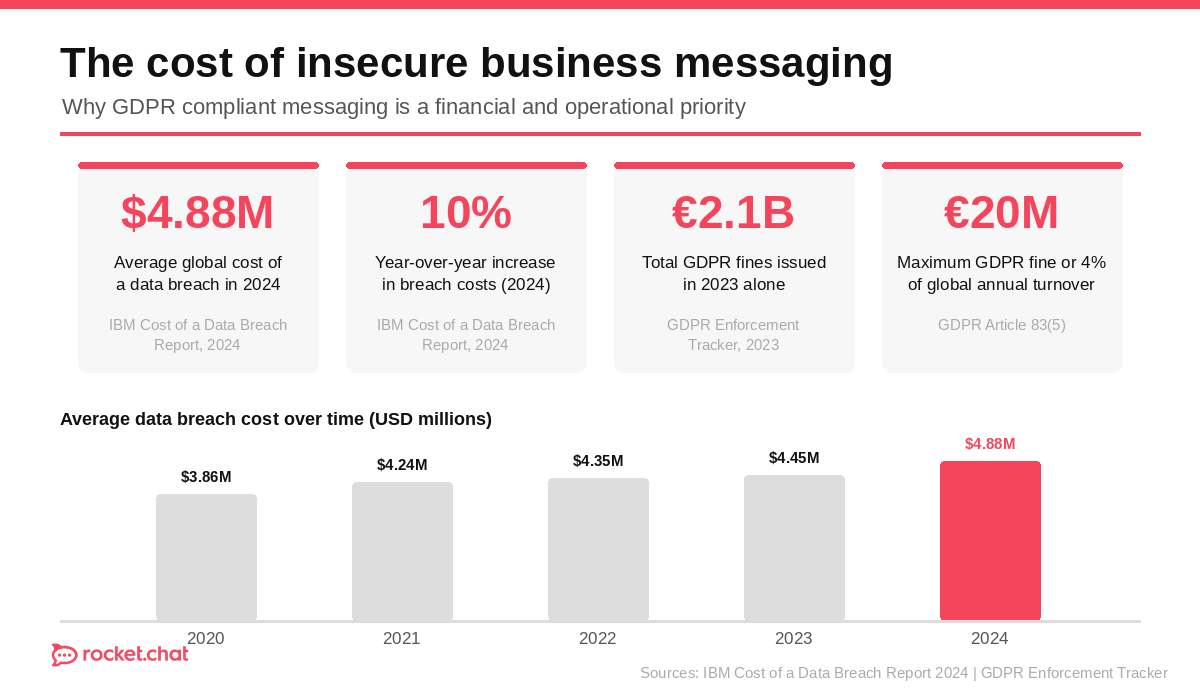
IBM's Cost of a Data Breach Report found that the global average cost of a data breach reached $4.88 million in 2024, a 10% increase year-over-year. Inadequate access controls and insecure communication channels remain among the leading root causes.
Beyond financial penalties, a breach damages customer trust in ways that are difficult to quantify.
A 2023 Cisco Privacy Benchmark Study found that 94% of organizations reported that customers would not buy from them if they did not protect data adequately.
Messaging as a compliance liability
Standard consumer apps — including widely used platforms hosted outside the EU — often fail GDPR requirements in several ways:
- Data stored on servers outside EU jurisdiction without adequate transfer mechanisms
- No documented data processing agreements (DPAs) with the platform vendor
- Limited or absent user deletion rights for stored messages
- Metadata (sender, timestamp, device) treated as non-personal, when it legally qualifies as personal data under GDPR
Organizations that rely on secure team chat platforms purpose-built for compliance have a measurably lower exposure to these risks.
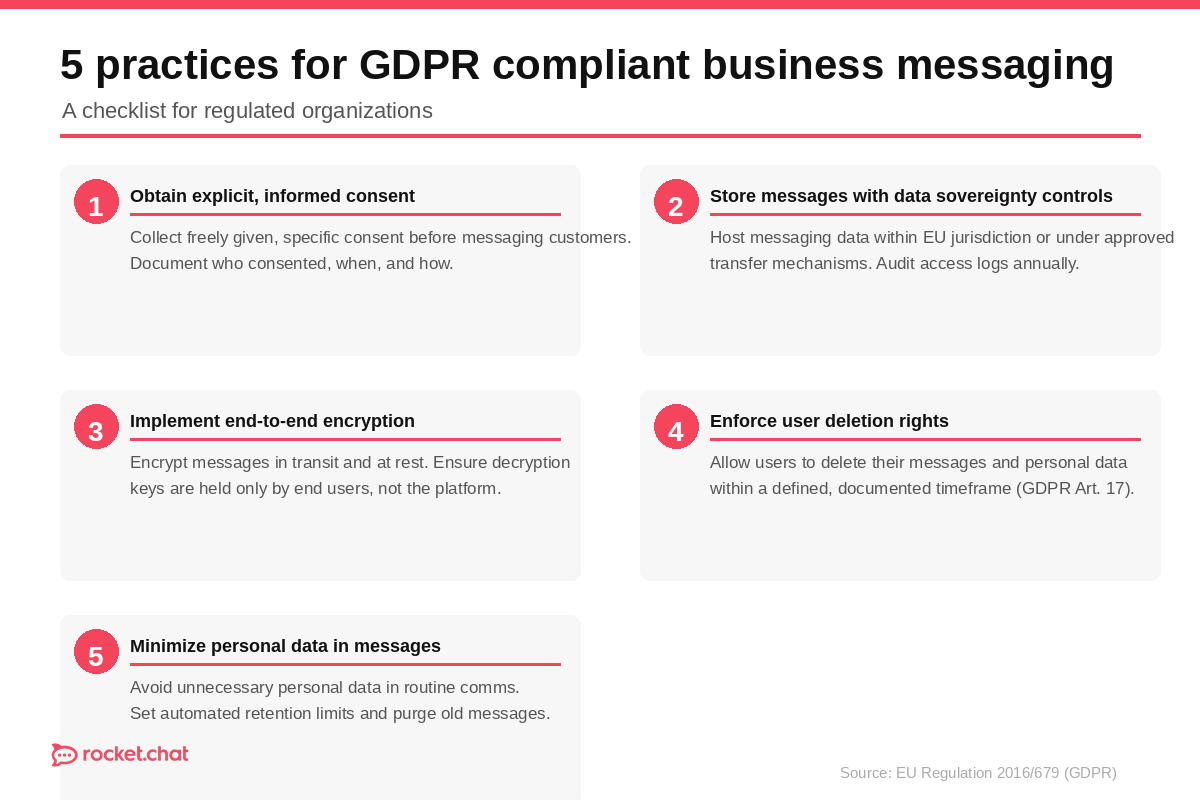
035 practices to ensure GDPR compliant business messaging
1. Obtain explicit, informed user consent
Before sending marketing or customer-facing messages, you must obtain consent that is freely given, specific, informed, and unambiguous. This means:
- Clearly stating what the message is for before collecting contact details
- Providing an equally easy opt-out mechanism as the opt-in
- Keeping documented records of consent (who, when, and how)
For internal employee communications, consent is not always the legal basis — legitimate interest or contractual necessity may apply — but the data minimization and transparency obligations still apply in full.
2. Store messages with data sovereignty controls
Where your messages are stored matters as much as how they are encrypted. Under GDPR, personal data may only be transferred outside the EU under specific conditions — an adequacy decision, Standard Contractual Clauses, or Binding Corporate Rules.
Organizations handling sensitive communications should deploy messaging infrastructure they fully control, either on-premises or in a private cloud within EU jurisdiction.
This is the foundation of data sovereignty in practice and ensures no third-party vendor can access your conversations without your explicit authorization.
Regular audits of message storage, access logs, and retention policies should be scheduled at least annually.
3. Implement end-to-end encryption
End-to-end encryption (E2EE) ensures messages can only be read by the intended sender and recipient — not by the platform provider, not by a cloud host, and not by an attacker intercepting traffic.
For businesses, E2EE should cover:
- Messages in transit
- Messages at rest (stored ciphertext)
- File attachments and metadata where possible
Encrypted messaging for business goes beyond basic TLS transport encryption. True E2EE means the decryption keys are held only by the end users, not the service operator.
For industries with heightened regulatory requirements — such as healthcare or defense — communication security practices need to extend to key management policies and regular cryptographic audits.
4. Enforce user rights, including message deletion
GDPR grants individuals the right to erasure ("right to be forgotten") under Article 17. For business messaging, this means users must be able to:
- Request deletion of their personal data, including stored messages
- Have that data deleted within a defined and documented timeframe
- Receive confirmation that deletion has been completed
Your messaging platform must technically support this workflow, not just your privacy policy.
If your platform cannot delete individual messages or user data on request, it is non-compliant regardless of what your terms of service say.
5. Minimize personal data in messages
Data minimization is a core GDPR principle (Article 5(1)(c)). Applied to messaging, this means:
- Avoid including unnecessary personal data — names, IDs, health data — in routine communications
- Set automated retention limits so old messages are purged once no longer needed
- Regularly review what data is collected through messaging integrations and bots
Organizations with mature compliance programs typically embed data minimization guidelines directly into their secure messaging policies and employee training.
04GDPR compliant business messaging: platform comparison
Choosing the right platform is as important as following the right practices. For businesses operating in regulated industries, the decision typically comes down to a shortlist of enterprise-grade platforms — all open-source or EU-aligned — that offer meaningful sovereignty and compliance controls.
A note on consumer apps: For individual use, Signal and Threema are privacy-focused options — but they lack the admin controls, audit logging, and data processing agreements that business GDPR compliance requires. The comparison below focuses on platforms built for organizational deployment.
Rocket.Chat
Rocket.Chat is an open-source, self-hostable platform built for organizations that cannot afford compliance compromises. It offers end-to-end encryption, role-based access controls, two-factor authentication, and complete deployment flexibility — including air-gapped environments with no external dependencies.
Because Rocket.Chat can be deployed entirely on your own infrastructure, your organization retains full data ownership with no vendor access to your conversations. It supports compliance with GDPR, HIPAA, FINRA, and NIS2 — making it a strong fit for government messaging use cases, mission-critical operations, and highly regulated enterprises. For European organizations evaluating US-hosted alternatives, it is a recognized Microsoft Teams alternative for EU government.
Mattermost
Mattermost is an open-source, self-hostable team messaging platform with a strong footprint in defense and regulated industries. It supports on-premises deployment, role-based access controls, and audit logging. End-to-end encryption is available but requires additional configuration and is not enabled by default. Mattermost is particularly popular with developer-heavy teams and organizations already operating secure infrastructure.
Element (Matrix)
Element is built on the open Matrix protocol, which enables federated, decentralized messaging. It supports end-to-end encryption and can be fully self-hosted. Several European government bodies — including the German federal government and the French military — have adopted Element-based deployments for sovereign internal communications. It is well-suited for cross-organization collaboration where federation between independently controlled servers is required.
Wire for Business
Wire for Business is the enterprise tier of Wire, offering end-to-end encrypted voice, video, and text with EU-based hosting options and a signed DPA. It supports guest access and cross-company collaboration without exposing internal directory data. Wire does not retain business data beyond the active service period, and users can delete messages at any time.
Microsoft Teams
Microsoft Teams is the most widely deployed business messaging platform globally, and it does offer GDPR compliance mechanisms — including EU data residency options, a signed DPA, and audit logging in higher-tier plans. However, it is a fully cloud-hosted, US-headquartered service with no self-hosting option, which makes it unsuitable for organizations requiring data sovereignty or operating in environments where third-party cloud access is prohibited. Regulated European organizations are increasingly evaluating sovereign alternatives to Microsoft Teams.
05Feature comparison: GDPR compliance for business messaging
The table below focuses exclusively on features relevant to GDPR compliance in an organizational context. It is a practical reference, not a comprehensive product review.
| Feature | Rocket.Chat | Mattermost | Element | Wire for Business | Microsoft Teams |
|---|---|---|---|---|---|
| End-to-end encryption | Yes | Optional | Yes | Yes | Partial |
| Self-hosting / on-premises | Yes | Yes | Yes | No | No |
| EU data residency | Yes | Yes | Yes | Yes | Add-on |
| Air-gapped deployment | Yes | Yes | Limited | No | No |
| Admin audit logs | Yes | Yes | Yes | Limited | Paid tier |
| Role-based access controls | Yes | Yes | Yes | Yes | Yes |
| Data processing agreement | Yes | Yes | Yes | Yes | Yes |
| Open source | Yes | Yes | Yes | No | No |
| Federation support | Yes | No | Yes | No | No |
| Best fit | Enterprise, gov, regulated industries | Dev teams, defense | Gov, federated comms | Business teams, cross-org | General enterprise |
Rocket.Chat is the only platform in this comparison that combines self-hosting, air-gapped deployment, federation, and full audit logging out of the box — the configuration that regulated industries most commonly require to demonstrate GDPR compliance end-to-end.
Rocket.Chat is the only platform in this comparison that combines self-hosting, air-gapped deployment, federation, and full audit logging out of the box — the configuration that regulated industries most commonly require to demonstrate GDPR compliance end-to-end.
06GDPR and related regulations: what to watch
GDPR does not exist in isolation. Organizations that achieve GDPR compliant messaging also need to be aware of related frameworks:
- NIS2 Directive: Expands cybersecurity obligations for essential and important entities across the EU. NIS2 compliance requires incident response capabilities and secure communication channels.
- Sector-specific rules: Healthcare organizations must additionally comply with national health data laws; defense and government bodies face requirements around out-of-band communication and defense-grade communication systems.
Last updated: 27 February 2026
Frequently asked questions
What makes a messaging app GDPR compliant?
A GDPR compliant messaging app must process only the minimum necessary personal data, store it within EU jurisdiction or under an approved transfer mechanism, support user deletion rights, encrypt data in transit and at rest, and maintain a documented data processing agreement with your organization. All five conditions need to be met simultaneously — meeting four out of five does not constitute compliance.
Does GDPR apply to internal employee messaging?
Yes, GDPR applies to internal employee messaging whenever those messages contain personal data — including names, contact details, or performance-related information. Employers need a lawful basis for processing that data (typically legitimate interest or contractual necessity) and must inform employees about retention periods and their rights over stored messages.
Can businesses use WhatsApp or Microsoft Teams for GDPR-compliant messaging?
Using WhatsApp or Microsoft Teams for business messaging carries meaningful GDPR risk, particularly around US-based data transfers and limited organizational data control. Both platforms have pursued GDPR compliance measures, but regulated industries — healthcare, finance, government — typically require platforms where the organization retains full data sovereignty and can produce audit logs on demand. Self-hosted alternatives remove most of this risk.
What is a data processing agreement and why does it matter for messaging?
A data processing agreement (DPA) is a legally required contract under GDPR Article 28 between your organization and any third-party platform that processes personal data on your behalf. Without a signed DPA, you are non-compliant regardless of the platform's own certifications or security features. Every messaging vendor you use to handle EU personal data must have one in place.
How long can businesses store messages under GDPR?
GDPR does not set a fixed retention period — it requires that messages be kept no longer than necessary for the purpose for which they were collected. In practice, this means businesses must define a documented retention policy per message category (e.g., customer support, internal team chat, sales communications) and configure their platform to enforce automated deletion at the end of each period.
What is the difference between encryption in transit and end-to-end encryption?
End-to-end encryption (E2EE) is significantly stronger than encryption in transit: with E2EE, only the sender and recipient can read the message — not even the platform operator. Standard encryption in transit (TLS) only protects data while it travels to the server; once it arrives, the server can read and store the plaintext. For GDPR compliant business messaging, E2EE is the higher standard and should be the default for sensitive communications.